

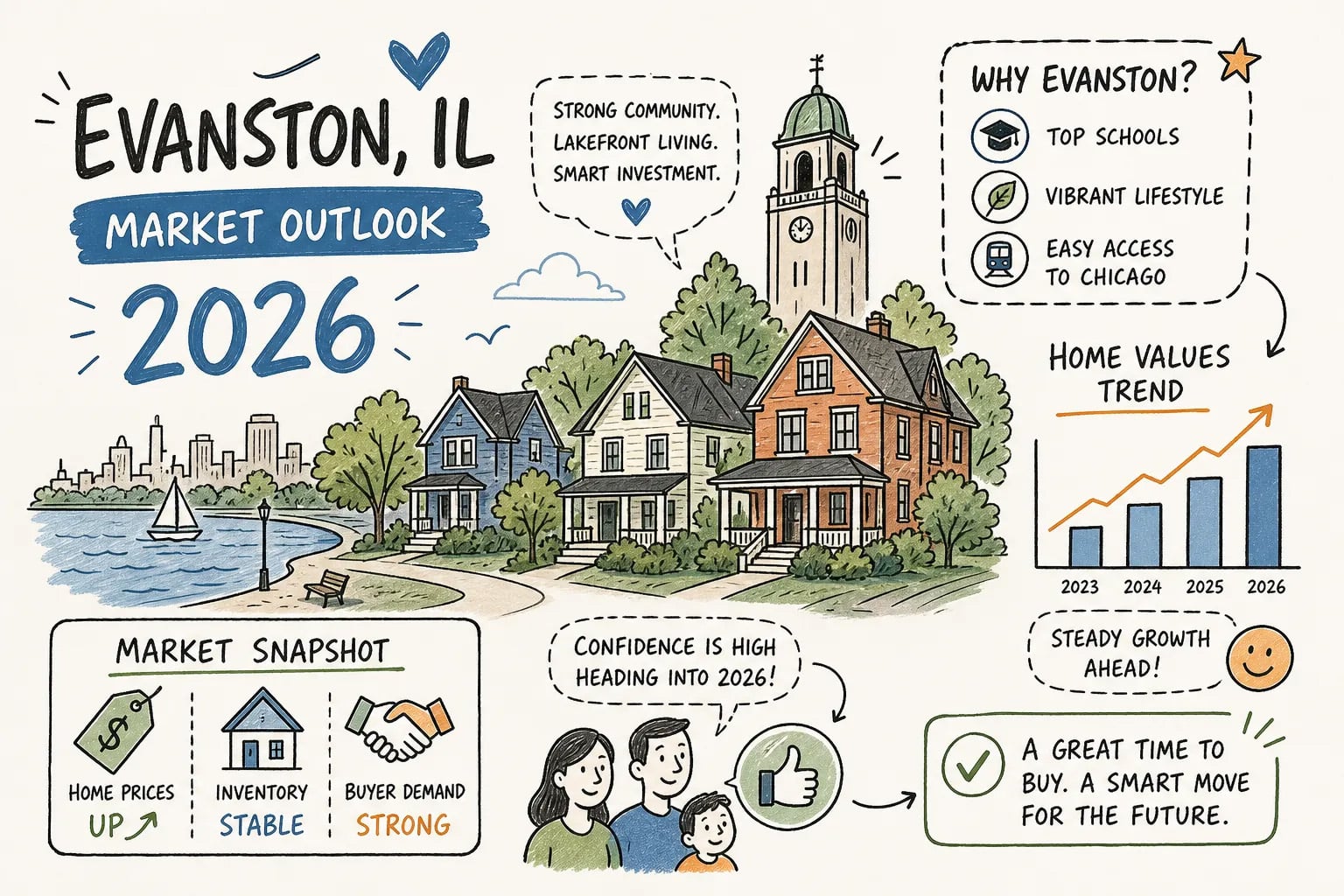
The Evanston real estate market in 2026 is a seller's market by every key measure. Median sale prices are hovering near $500,000, up roughly 6.5% year over year, and total housing inventory sits below 1.5 months of supply citywide. Buyers are dealing with limited options and real competition at the offer table. Sellers hold meaningful leverage, particularly in the condo segment.
This report pulls together MLS figures, Cook County assessment data, and neighborhood-level sales activity to give you a clear picture of where prices stand, which areas are moving fastest, and what property taxes look like for buyers budgeting in 2026. Stephanie Sullivan, a Chicago and North Shore broker and real estate expert who tracks Evanston MLS comps daily, provided the local context that broader market reports tend to miss.
Key takeaways
- Median price near $500K: Evanston's citywide median closed sale price sits around $500,000, up approximately 6.5% year over year.
- Inventory is critically low: Active supply ranges from 1.1 to 1.7 months citywide, with condo inventory dipping as low as 0.7 months earlier in 2026.
- Two very different segments: Single-family homes closed at a $925,000 median; condos and townhomes closed at $356,000, creating two distinct entry points.
- Neighborhood speed varies widely: West Village averages about 11 days on market; West Evanston's active listings are sitting closer to 54 days.
- Property taxes are rising: The median Evanston homeowner's annual tax bill now exceeds $8,200, up roughly 5% after the latest Cook County reassessment.
- Sellers still have leverage: Evanston home values have climbed for three consecutive years and buyer demand has not meaningfully contracted.
What are Evanston home prices doing in 2026?
Three major data sources agree on the direction even when the exact figure varies. Redfin reports a median sale price of $500,317, up 6.5% year over year as of September 2026. Realtor.com shows $465,000, up 10.98% over the same period. Homes.com reports $450,000 with minimal year-over-year movement, based on a 12-month rolling median. Zillow's August 2026 figure lands at $511,667. These numbers look like contradictions, but they aren't.
The variation reflects different measurement windows and methodologies, not conflicting market realities. Redfin and Realtor.com measure closed sale prices on different lag windows; Homes.com smooths out seasonal swings with a longer rolling period. For buyers making offers, the most actionable figure comes from the shortest available closed-sale window, which puts the Evanston real estate market solidly in the $500,000 range right now.
The through-line is clear: Evanston home values are rising in 2026, regardless of which source you pull. The $465,000-to-$511,667 spread reflects methodology, not market uncertainty. What pulls the citywide median around most dramatically is the mix of property types closing in any given month. Keep that in mind before drawing conclusions from a single headline number.
How competitive is the Evanston housing inventory right now?
MLS data as of mid-October 2026 shows roughly 115 to 116 active listings citywide, with absorption-rate analyses putting supply anywhere from 1.1 to 1.7 months depending on the measurement approach. All of those figures sit well below the 4 to 6 months of supply that typically defines a balanced market. For context, a condo-specific estimate from April 2026 put condo inventory at just 0.7 months, extreme seller's market territory by any standard.
The average days on market sits at 34 days in MLS-based data, while Redfin's broader measure shows 44 days for September versus 42 days a year earlier. That modest uptick is not a sign of softening demand. It reflects overpriced listings sitting longer and pulling the average up. Sellers who price accurately are still moving quickly. Buyers who find a home they want genuinely cannot afford to take two or three weeks to decide.
Which Evanston neighborhoods are moving at different speeds?
The Evanston real estate market is not one uniform market. Price levels and sales velocity vary significantly depending on which part of the city you are watching, and lumping everything into a single citywide number can lead buyers and sellers to make decisions based on data that does not apply to their street.
West Village and Downtown Evanston
West Village is the fastest-moving submarket in current data, with a median days on market of approximately 11 days. Median closed sales hover around $420,000, though Zillow's typical home value estimate for the area runs closer to $528,000, a wide spread that reflects the mix of property types transacting.
Downtown Evanston trends lower in price, ranging from $399,000 to $485,000 depending on the measure, with homes averaging 26 to 31 days on market. Both areas attract buyers who prioritize walkability, lakefront access, or transit proximity, and that demand has remained consistent through 2026.
West Evanston, Northwestern corridor, and North Shore
West Evanston carries the highest reported median among the named neighborhoods at roughly $530,000. The velocity data here is mixed: some neighborhood-level series show 18-day averages for recent closed sales, while active listing data shows 54 days, suggesting current inventory is priced above where buyers have been willing to move quickly.
The Northwestern corridor and Central Street area show a Zillow typical value near $558,000, making it the priciest submarket in Evanston by available data. Lakeshore listings are pushing $950,000 at the top end, and North Evanston sits around $725,000.
| Neighborhood | Median price (2026) | Approx. days on market | Market character |
|---|---|---|---|
| Lakeshore | $950,000 (listing median) | Not reported | Highest-priced; luxury buyer pool |
| Northwestern / Central Street | ~$558,000–$685,000 | ~17 days (sales data) | High demand; limited transaction-level data |
| West Evanston | ~$530,000 | 18 days (recent sales) / 54 days (active) | Priciest named submarket; uneven velocity |
| Downtown Evanston | $399,000–$485,000 | 26–31 days | Moderate price; steady walkable demand |
| West Village | ~$420,000 (closed) / $528,000 (Zillow) | ~11 days | Fastest-moving submarket in current data |
| Southeast Evanston | ~$355,000–$437,500 | 20–31 days | More accessible price point; solid liquidity |
Are condos or single-family homes the stronger buy in 2026?
The price gap between the two segments is substantial enough to define entirely different buying experiences. In the July through September 2026 period, 85 single-family homes closed at a median price of $925,000. In the same window, 126 condo and townhome transactions closed at a median of $356,000. That is a $569,000 gap, roughly 2.6 times the median condo price. The two segments are operating in parallel but largely separate markets.
Condos generated 49% more closed transactions than single-family homes in the latest quarter, and supply is tighter: condo inventory dropped as low as 0.7 months of supply earlier in 2026. That combination puts condo buyers in the most acutely competitive position in the Evanston real estate market right now. The $300,000 to $400,000 condo range sees the most direct buyer-on-buyer competition, and well-priced units are not staying available long enough for leisurely decision-making.
The single-family segment at a $925,000 median attracts a narrower buyer pool, which means fewer competing offers on any given home. But supply at that price tier is also constrained, so sellers still hold leverage. Both segments favor sellers in 2026. The dynamic is simply more acute in condos because volume is higher and inventory is thinner.
What do property taxes look like for Evanston buyers in 2026?
Cook County's most recent reassessment raised Evanston residential property values by approximately 20% in aggregate after appeals, compared to 12.5% for nonresidential properties. That gap matters because it shifted who carries the township's tax burden. Residential property's share of the taxable base rose from 69% to 70.4%. As a result, the median Evanston homeowner's annual tax bill now sits above $8,200, up roughly 5% from the prior cycle.
The reason residential bills went up while commercial bills went down comes down to appeals. The initial reassessment raised nonresidential values by 31.8%, but successful appeals reduced that increase by more than 60%. Residential increases were reduced by only about 11%, leaving homeowners absorbing a larger share of the overall levy. A 20% assessed value increase does not translate directly into a 20% tax increase, but it does push your bill up when the overall levy holds steady and your relative share of the base grows.
Cook County's assessor estimates also lag current market pricing. For single-family homes, the assessor's 2025 median estimate was $636,000 against a 2024 median sale price of $675,000, a 6% gap. For condos, the gap is wider: a $265,000 assessor median versus a $294,000 market median, roughly 10% below current transaction evidence. Buyers should calculate their total cost of ownership using the assessed value plus the current tax rate, not the assessor's estimate of what the home is worth. Those are two different numbers, and confusing them leads to budget surprises at closing.
What buyers and sellers should do right now
For buyers, the preparation timeline needs to be shorter than it might feel comfortable being. In a market with roughly 116 active listings and 34 average days on market citywide, and with the fastest neighborhoods turning over in 10 to 14 days, pre-approval needs to be current, not from six months ago. Buyers targeting West Village or Downtown Evanston should plan to move within 7 to 10 days of finding a home they want. Buyers targeting the condo segment at $300,000 to $400,000 should have their offer terms ready before they tour, because that price tier is the most competitive in the city right now.
For sellers, 2026 still represents a strong window, but precision matters more than it did two or three years ago. Evanston home values have risen for the third consecutive year, inventory remains well below balanced-market thresholds, and the buyer pool has not significantly contracted. Sellers who price within 3 to 5% of recent comparable closed sales are seeing strong activity. Overpricing by more than that is what is driving the longer days-on-market figures in areas like West Evanston. Staging and condition matter more at the $500,000 to $600,000 range than they did in 2023 or 2024, because buyers at that price point have become more selective as their options have narrowed.
The bottom line on the Evanston real estate market in 2026
Two forces are defining the Evanston real estate market right now: rising prices and severely limited inventory, and together they are producing active competition across most neighborhoods. Whether you are buying your first condo in Downtown Evanston or selling a single-family home in West Evanston, year-old averages will lead you to the wrong conclusions in a market moving this fast.
The citywide median closed sale price sits near $500,000, up roughly 6.5% year over year. Condo inventory has touched 0.7 months of supply. Single-family homes command a $925,000 median, and property taxes now exceed $8,200 annually for the median homeowner. The decisions that matter most, when to list, how to price, which neighborhoods to prioritize, and how to structure a competitive offer, all depend on current data.
Stephanie Sullivan, a Chicago and North Shore broker and real estate expert, monitors Evanston's MLS activity daily. Reach out directly for a free, no-pressure consultation on what the current numbers mean for your specific situation.
Frequently Asked Questions
How recent should my mortgage pre-approval be when shopping in Evanston right now?
I recommend that your pre-approval be current and not from six months ago. In this market buyers, especially those targeting West Village or Downtown, should be ready to move within 7 to 10 days of finding a home they want, so a fresh pre-approval prevents delays that cost you opportunities.
Are condos more competitive than single-family homes in Evanston in 2026?
Yes, condos are more competitive right now. Condo inventory dipped as low as 0.7 months and condos produced 49% more closed transactions than single-family homes in the latest quarter, putting the $300,000–$400,000 condo tier in the most acute buyer-on-buyer competition.
If I'm selling, how close to comparables should I price my home to get strong activity?
Price within about 3 to 5% of recent comparable closed sales to see strong activity. Overpricing beyond that is what's driving longer days on market in areas like West Evanston, while sellers who price accurately are still moving quickly.
Do Cook County assessor values match current market prices for Evanston homes?
No, assessor estimates lag market pricing and are lower than recent sale medians. For single-family homes the assessor's 2025 median was $636,000 versus a 2024 median sale of $675,000 (about a 6% gap), and for condos the assessor median was $265,000 versus a market median near $294,000 (roughly a 10% gap).
Check out this article next